


Duration: daily tour
Location: Hanoi, Vietnam
Price from: from $41
Trip code: 1100 Book now
General
Hanoi Excursions & Daily Tours (#1100)
As the capital of Vietnam for almost a thousand years, Hanoi is considered to be the cultural center of Vietnam, where every dynasty has left behind their imprint. Even though some relics have not survived through wars and time, the city still has many interesting cultural and historic monuments for visitors and residents alike.
Hanoi at Your Sight – Fullday (Trip code 1101)
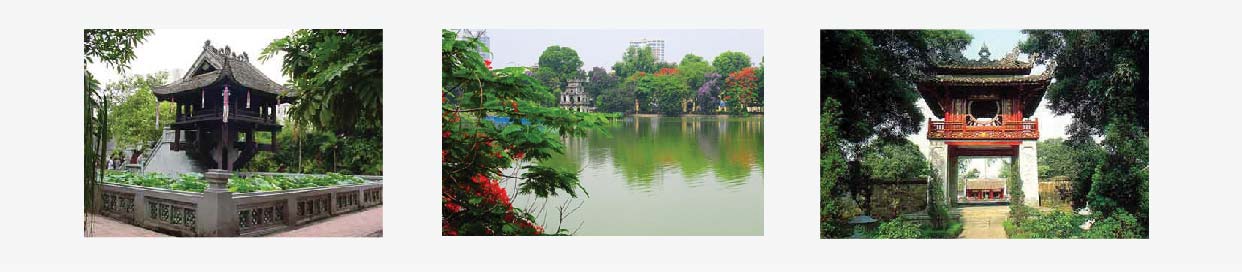
Start at your hotel at 08:30, transfer to visit Ho Chi Minh complex included his mausoleum, his former residence, house on stilt & one pillar pagoda. After that, we visit Temple of Literature: the first university of Vietnam and Hoan Kiem Lake with Ngoc Son Temple.
In the afternoon, visit Ethnology Museum (closed on Monday) and explore Hanoi Old Streets by one hour cyclo ride.
Tour ends at your hotel at about 16:30.
Inclusive
- Transportation with a/c
- Mineral water and wet wipe
- Private English speaking guide
- Entrance fees
- Cylco fee (one person/cyclo)
- No lunch included
|
Price is valid until 31.10.2025 |
1 pax | 2 pax | 3 – 4 pax | 5 – 6 pax |
| 155 | 91 | 70 | 55 | |
| Book this | ||||
Traditional Handicraft Villages – Full day
* Hanoi – Bat Trang pottery village & Van Phuc silk village (Trip code 1102a)
08:00: pick up at your hotel, drive to visit Bat Trang Pottery Village – Bat Trang, which translates as ‘bowl-making village’ became famous for its bricks and for its bat dan, a type of bowl popular in the Red River Delta. Bat Trang was so well known that its bricks. The village’s ceramics were finished with five types of glaze: iron brown, blue and white, ivory, moss green, and cracked. The most typical designs, and the ones that are most popular to this day, involve a combination of white and deep cobalt blue.
In the afternoon, we continue to Van Phuc silk village. In Van Phuc, one is confronted with an initially bewildering array of silk products, from the raw materials, to ready-to-wear garments, to a myriad of silk accessories.
The local silk is known for its smooth and lightweight appearance, qualities that enable it to be dyed more colours to suit a variety of skin tones.
Back to your hotel in Hanoi.
Inclusive
- Transportation with a/c
- Mineral water and wet wipe
- English speaking local guide
- No lunch included
Hanoi – Dong Ngac culture village (Trip code #1201.1)
Dong Ngac Ancient Village or Ke Ve Village in North Tu Liem district, 13km away from Hanoi downtown, located at the foot of the Thang Long Bridge and you will see the village sitting at, famous as “village of scholars”, old architectural designs and traditional handicrafts, you can see this village in a half or one full day trip
Itinerary: Hanoi – Dong Ngac Ancient village – Half day with lunch (#1201.1)
08.00: Your guide and driver will meet you at your hotel and take you to Dong Ngac cultural village, to see a cultural heritage site in honor of its educated and heroic people recognized by the kings of Vietnam.
8.30: Visit a local market tour, chance to experience the bustling market and local life, purchase the some offering for families we will visit
Take a short walk from Dong Ngac market to the hosting family’s house for a welcome drink and get ready for the biking around the village
09.30: Start biking and venture deeper into the village, see the Communal House, the grounds and architecture of which are built in the shape of a dragon, the oldest house in the village belongs to the Do family and is more than 300 years old or the Nguyen family with a house given by the King. Passing by the oldest school in the Village built in 1921
10.30: Back to the hosting family, it is time for your private cooking demonstration, enjoy the lunch with what you have cooked.
After the lunch, the car transfer you back to your hotel around 13.00
The trip ends!
Itinerary: Hanoi – Dong Ngac ancient village & cycling to Lien Mac village – Full day with lunch (#1201.2)
08.00: Your guide and driver will meet you at your hotel and take you to Dong Ngac cultural village, to see a cultural heritage site in honor of its educated and heroic people recognized by the kings of Vietnam.
8.30: Visit a local market tour, chance to experience the bustling market and local life, purchase the some offering for families we will visit
Take a short walk from Dong Ngac market to the hosting family’s house for a welcome drink and get ready for the biking around the village
09.30: Start biking and venture deeper into the village, see the Communal House, the grounds and architecture of which are built in the shape of a dragon, the oldest house in the village belongs to the Do family and is more than 300 years old or the Nguyen family with a house given by the King. Passing by the oldest school in the Village built in 1921
10.30: Back to the hosting family, it is time for your private cooking demonstration, enjoy the lunch with what you have cooked.
Continue our day trip by cycling to the Lien Mac village, famouse by flower and vegetable productions. Time to see, join the farming activities, interact with local
15.30: Cycling back to Dong Ngac village
The car will transfer you back to your hotel around 16.30
End of trip!
Price valids 2024-2025
Price in USD per person, private tour that varies upon the number of participants
| group of 2-3 people | group of 4-6 people | |
| Dong Ngac Ancient village – Half day with lunch (#1201.1) | 60 | 45 |
| Dong Ngac ancient village & cycling to Lien Mac village – Full day with lunch (#1201.2) | 70 | 53 |
| Book this: info@vietnamimpressive.com | ||
Included:
Car transfer from/to your hotel in Hanoi
Bike fee
English-speaking tour guide
1 bottle of water
Cooking class & lunch at a local house
Excluded: travel insurance, hotel in Hanoi, personal expense, tip & gratuties for driver, guide, local host
* Hanoi – Bat Trang pottery village, Dong Ho folk painting & Dong Ky carpentry village (Lunch) (Trip code 1102b)
08.00: pick up you at your hotel and travel along the Red River to reach Bat Trang pottery village (45 mn by car). You will walk around the village, visit families that have the workshop of making the pottery. See how the villagers find the mud, how to make the potteries and draw on them…You also can do pottery for yourself for souvenir
09.00 Visit the pottery market beside the river where you will see numerous kind of pottery products in many beautiful colours.
10.30 Car take you through the rice field to get to “Dong Ho” painting village. Here, you will find the special paints made by the artists. You will know about the way they make the paper, the way the paint and also talk with the old painters.
11.30 Have lunch in the local restaurant.
13.00 Visit the carpentry village of Dong Ky – the most famous carpentry village in Vietnam. They make many beautiful products with carving nice pictures on. You can buy some small products for souvenirs here.
Inclusive
- Private car/ van with a/c
- Mineral water and wet wipe
- Private English speaking local guide
- Entrance fees
- Bicycle
- Standard lunch at local restaurant as stated in the program
Hanoi – Duong Lam Ancient village & Van Phuc Silk village (Lunch) (Trip code 1102c)
08.30: pick up at hotel and travel west of Hanoi to Duong Lam village, a purely agricultural village of the Northern Red River delta where still preserved are many hundred-year-old houses. Upon arrival, bike along tiny ancient alleys to visit Mong Phu temple in Mong Phu hamlet – the only hamlet whose original village entrance gate remains intact, dedicated to national heroes. Continue riding around the village to discover the daily life and farming, practice of Vietnamese peasants along the terrace with a stop to visit ancient houses: the biggest ancient house was build 200 years ago and the most ancient house dates back to 400 years ago.
Lunch at local restaurant. After lunch, visit Ngo Quyen temple and Phung Hung temple, dedicated to two national heroes then visiting Mia Pagoda, built in 15th century.
On the way back Hanoi, visit Van Phuc Village, the most famous traditional village for weaving silk of Vietnam. Discover how they create the perfect silk products, a complex technical process includes several work stages such as sewing, weaving and dyeing silk. Have free time for shopping at Van Phuc Silk Village. You can also buy the silk products as souvenirs to bring home.
Back to your hotel in Hanoi.
Inclusive
- Private car/ van
- Mineral water and wet wipe
- Private English speaking local guide
- Entrance fees
- Bicycle fee
- Standard lunch at local restaurant as stated in the program
Prices valid until 31.10.2025 (except public holidays)
Price is nett per person in US$, private tour, tax, service charge included in the party of
|
Group size
|
1 pax | 2 pax | 3 – 4pax | 5 – 6pax |
| Trip code 1102a | 171 | 90 | 66 | 47 |
| Trip code 1102b | 192 | 112 | 86 | 66 |
| Trip code 1102c | 218 | 127 | 98 | 75 |
| Book this | ||||
Village Life and Water Puppetry – Halfday in the afternoon (Trip code 1103a)
15:00: pick up at your hotel, drive to visit Tay Tuu flower village – Proud daisies curtsey in the breeze, showing off their finest colours in the glare of the lights, while dainty roses hide shyly beneath paper covers, seeking warmth from the cold night air.
You will have chance to talk to the local villagers taking care and waterring flowers
18:30: Attend the unique Vietnamese art performance of water puppetry
19:30: Drop off at hotel by car. Trip ends.
Inclusive
- Transportation with a/c
- Mineral water and wet wipe
- Private English speaking guide
- Water puppetry ticket cost
- No lunch included
|
Prices valid until 31.10.2025 |
1 pax | 2 pax | 3 – 4pax | 5 – 6pax |
| 159 | 90 | 70 | 52 | |
| Book this | ||||
Hanoi City by Jeep – Full Day Trip (#1103b)
Joint small group: 2-6 people (with local lunch)
Start time: about 7.45-8:00am; Finish time: 16.00
Itinerary: Long Bien bridge – Co Loa village – HCM mausoleum outside – B52 lake , West lake – local market
Full Day City:
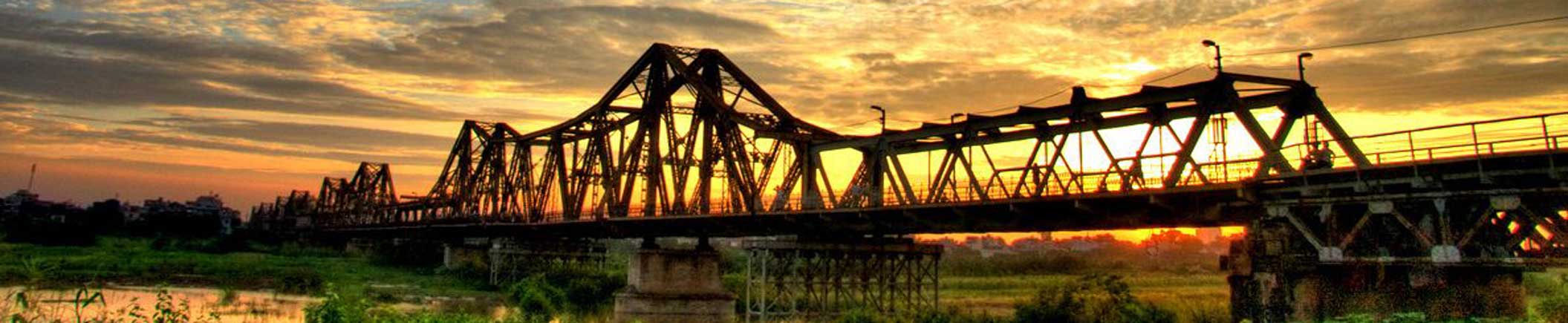
In the morning: our guide meets you at the hotel in the city center or at the meeting point, we drive toward the Red river, passing Long Bien Bridge; a historic cantilever bridge across the Red River that connects two districts on the river banks. You can enjoy the rural villages, rice paddies fields, farms… Next to the ancient village of Co Loa, see the local life, and meet & talk with a local family.
Back to the city center for a local lunch
In the afternoon: we drive to the railway tracks; now it has been stopped to take a coffee beside the railway track, we will stop nearby there; we can see how the local life & work, just centimes from the train tracks in tall narrow houses. Next, we move to Ho Chi Minh Mausoleum, you will see from the outside, an overview of the area including the president’s place, the parliament house, and all government offices, our guide will tell you about the history and story of Hanoi. After that, we pass by the botanical garden and arrive at B52 Lake to see the B52 Crash still in the lake, this US bomber was shot down during the 1972 bombing raids of Hanoi, a poignant reminder of recent history. We drive to the West Lake on Thanh Nien Street which divides into the West Lake & Truc Bach Lake. Next, we move to the An Duong local market and go shopping to see how local life is. After that, we go to a hidden gem to see a vegetable farm/or kumquat farm.
Our next ride takes us along the riverside to see a hidden gem on the island, see people farming, chance to meet and chat with people.
Back to the center, time to relax and enjoy a Vietnamese Egg coffee – a famous drink in Hanoi
The tour ends, and we drop you off at the hotel in the city center.
Note: Drop-off time is subject to traffic, weather…so the finished time could be later than expected
Half Day City – Inside of Hanoi (4 Hours)
Morning Tour starts: about 7.45-8:00 am; Finish time: 12:00 noon (ending with the lunch)
Afternoon Tour starts: about 12:15-12:30 noon; Finish time: 17:00 (starting with the lunch)
Sunset & Night Tour stars: at about 16:45-17:00; Finish time: 21:30 (ending with the dinner)
Itinerary: our guide meets you at the hotel in the city center or at the meeting point, we will explore the daily life of the Hanoians, see the maze of backstreets, tiny alleyways, local homes, and schools…
Next, we pass by the Ho Chi Minh mausoleum visit from the outside, the Taoist temple of Tran Vu, the first university Temple of Litterature, and the historical railway tracks. We also explore the old quarter of Hanoi, the biggest West Lake, the Hanoi Opera House, and the historical Long Bien Bridge.
Enjoy the local specialties of Hanoi. The tour ends, we drop you off at the hotel in the city center.
Half Day Countryside of Hanoi /Red River Delta (4 Hours)
Morning Tour starts: about 7.45-8:00 am; Finish time: 12:00 noon (ending with the lunch)
Afternoon Tour starts: about 12:15-12:30 noon; Finish time: 17:00 (starting with the lunch)
Itinerary: our guide meets you at the hotel in the city center or at the meeting point, we drive toward the Red river, passing Long Bien Bridge; a historic cantilever bridge across the Red River that connects two districts on the river banks. You can enjoy the rural villages, rice paddies fields, farms… Next to the ancient village of Co Loa, Co Loa now is serving as not only a cultural relic and evidence of ancient … values and familiar images of a peaceful northern village. Enjoy your time walking around the paths, see the local life, meet & talk with a local family.
Back to the city center for a local lunch
The tour ends, and we drop you off at the hotel in the city center.
Note: Drop-off time is subject to traffic, weather…so the finished time could be later than expected
Inclusive
Touring by Jeep, transfer & sightseeing as per program.
English-speaking guide, all entrance fees, Local lunch, free one drink, rain poncho (if needed)
Exclusion: Drink/beverages, travel insurance, vat tax, tips for tour guide, driver and personal expenses, and others that are not mentioned in the inclusions
|
Prices in USD per person valid for 2024 – 2025 |
Full Day Tour | Half Day City 4H AM/PM or Sunset & Evening |
Half-Day Countryside 4H Morning Afternoon |
| 137 | 64 | 95 | |
| Book this | |||
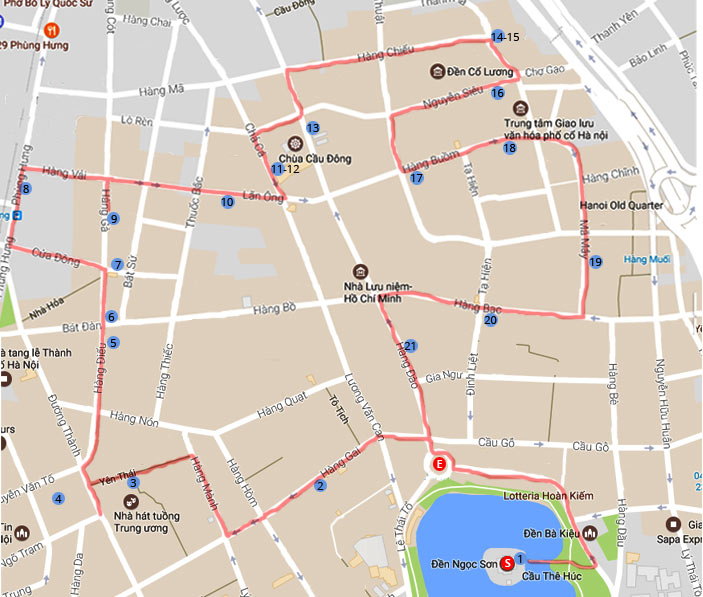
Hanoi, 36 Old Streets (Trip code 1104a) Walking Tour Map
Start: North end of Hoan Kiem Lake (at the Ngoc Son Pagoda).
Finish: Return to the north end of Hoan Kiem Lake (to Dong Kinh Nghia Thuc Sq.).
Time: 1,5 – 2 hours without stops; up to 3 hours with exploring, coffee, and chatting.
Best Times: From early morning.
Worst Times: Middle of the day (too hot).
The best way to really experience Hanoi’s Old Quarter is on foot. As you explore the route below, stop for coffee at a local cafe or a storefront geared to tourists in the backpacker area of the quarter. Stop for a chat; folks are busy but friendly if you take the time to connect. Photographers will want to set out early and catch the dynamic colors of the morning sun, which set off the rich yellowed plaster of older buildings and makes the colors of produce in the markets more vibrant.
This route is a large clockwise circle through the Old Quarter. Walking times vary depending on your clip and your interest in the details, but generally, allow a few hours.
Note: Try to study the map discreetly and know your next turn before arriving at an intersection. If you ask for directions, motorbike or taxi drivers will just implore you to hire them for a ride and even try to confuse you. Learn to look for distinct rooflines. Just a short time in the Old Quarter will have you distinguishing a Chinese temple or community house from a tube house or more French-influenced construction.
1. Hoan Kiem Lake
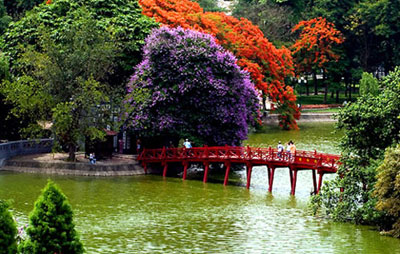
Start with a visit to the Ngoc Son pagoda on the North end of the lake. Cross the red bridge of the rising sun to reach the temple. From this most prominent point in the city, follow the Northern edge of the lake heading west and cross over the busy traffic circle. This busy square is known as the Dong Kinh Nghia Thuc Square (The Tonkin Free School Movement Sq.), named for the early-20th-century nationalist movement that would eventually spawn grassroots Communism in Vietnam.
West from the square is:
2. Hang Gai Street (Hemp St.)
This busy avenue marks the southern boundary of the Old Quarter. Hang Gai no longer supports hemp outlets as in days of old (the street would also host print shops and bookstores in the 19th c.) but is lined with boutique shopping, galleries, and silk tailors. Just a few hundred meters west of the traffic circle (on the left) you’ll find a large banyan tree out in front of what was once a prominent communal house at no. 85 Hang Gai. The tree is one of the finest specimens of an old banyan in the city, a perfect example of nature’s adaptability as heavy roots cleave large stones and masons have built around the old tree for centuries. The sight is like a small temple, with sticks of incense wedged between knobs of the tree and offerings of rice whiskey lining the base of the tree.
Turn right off of Hang Gai and look for a small street sign pointing to:
3. Tam Thuong Alley
Follow a few crooks in this quiet little alley and you come to the Yen Thai Communal House, a classic low tile roof over a wooden entry that gives way to a quiet courtyard. Just across the street are a few guesthouses popular with French backpackers. Tam Thuong terminates at Yen Thai Street where you’ll make a left and, in the morning, walk through a small open-air market with great morning light for photography.
Turn right at the end of Yen Thai Street onto Hang Da Street:
4. Hang Da Market and Hang Dieu Street
At the intersection of Yen Thai and Hang Da is the Hang Da Market, which is a large, local dry-goods and clothing market. After a quick look, head north on Hang Da — don’t miss the large bird shop with a wall of bamboo cages on the northern corner of the Hang Da Market.
Continuing north, Hang Da becomes Hang Dieu Street. Hang Dieu was traditionally the area for tobacco and pipe sellers; keep an eye out for the filigreed colonial edifices at no. 66 and no. 77 Hang Dieu (you’ll have to look up to distinguish these from the concrete clutter).
5. Take a Break–Bun Bo Nam Bo, at 67 Hang Dieu St. (tel. 04/923-0701), serves one of Hanoi’s most popular one-dish noodle specialties.
Turn right off of Hang Dieu onto:
6. Bat Dan Street
This street once housed sellers of clay bowls that were brought to the city from riverside workshops along the Red River. No. 33 Bat Dan is a very ornate and colorful communal house.
Turn left (go north) on Thuoc Bac Street, once an area for traditional medicines. Then turn left (west) on:
7. Hang Phen Street
At the corner of Hang Phen and Bat Su, look for a preserved traditional house, characterized by its low tile roofline, at no. 52 Bat Su (also note the cozy little coffee shop on the corner, good for a rest and to watch the busy street life).
Carry on along Hang Phen until it becomes Cua Dong Street, which brings you to the eastern edge and wall of the Hanoi Citadel built by the Nguyen dynasty in the 1800s. Cua Dong Street terminates at the wall of the Hanoi Citadel.
Turn right off of Cua Dong onto:
8. Phung Hung Street
Running along the wall of the city’s old citadel, what marks the western edge of the Old Quarter, Phung Hung Street is a notable sight among Vietnamese tourists for the publication offices of an important Communist paper at no. 105 Phung Hung. There’s a plaque that notes this spot as a historical vestige, but if you spend too much time studying the shuttered colonial edifice, local folks might get edgy, thinking you’re a spy of sorts.
Turn right off of Phung Hung onto:
9. Hang Vai
Translated as “Cloth Street,” Hang Vai is the bamboo district. The busy exteriors of small warehouses are lined with stands of cut bamboo poles, some more than two stories in height. This is the raw material for those wonderful Doctor Seuss scaffoldings you see on construction sites. The shops also sell bamboo tobacco pipes of the “bong” variety, some quite elaborate. At the corner of Hang Vai and north-south Hang Ga, keep an eye out for the communal house at no. 44 Hang Ga St.: A corner door cut into the white plaster and flanked by Chinese script ushers you into a small courtyard area with banyan trees and a small temple to Bach Ma, the White Horse, a god associated with Hanoi. Carrying on east on Hang Vai, look for the entrance to the communal house at no. 7 Hang Vai.
Heading east, Hang Vai becomes:
10. Lan Ong Street
One of the most interesting parts of the Old Quarter, Lan Ong Street is still home to a large enclave of ethnic Chinese who sell the herbs and medicines of old from small storefronts that date back to the origins of the quarter. The best shops are on the right side as you head east. Here you’ll find picturesque little interiors with walls lined in massive dark wood cabinets with tiny drawers and buckets and bins all around with the most curious assortment of dried goods you’ll ever see. This is the kind of place where, sadly, you might be able to buy a bear’s gall bladder or a monkey’s paw. The buildings all along this short stretch are originals dating back as far as the 17th century. Look for the busy elementary school at no. 42 Lan Ong, which was once the communal house of the area’s Chinese population. Just across from the converted communal house and all along the length of the street, look for low roofs and narrow entries, especially those with tile roofs covered in moss, as these are original Chinese homes.
A quick left (north) turn brings you to:
11. Cha Ca Street
Following Lan Ong Street, heading east, cross the famous Cha Ca Street (Fish St.). Make a left (north) and look for the Cha Ca La Vong restaurant, which serves one of Hanoi’s most famed dishes.
12. Take a Break–Just across from Cha Ca La Vong restaurant, you’ll find the Hoa Sua Cafe (11B Cha Ca St.; tel. 04/923-1500), a combination school and restaurant (they now have a number of locations throughout the city), where young students serve good coffee and cakes.
Returning to eastbound Lan Ong, turn left (north) onto Hang Duong.
13. Hang Duong Street
Hang Duong Street (Sugar St.) is lined with traditional constructions, foremost of which is the communal house on the left as you go north at no. 38 Hang Duong St. It has a stunning banyan tree in the courtyard and a dark, alluring charm to its smoky interior. Note: Hang Duong is a pedestrian area on weekend nights and becomes a busy little market for tourist trinkets and local goods.
A short detour off of Hang Duong is the 13th-century Thanh Ha Communal House, just a short walk east on Ngo Gach Street (Brick St.).
Continue north on Hang Duong, then turn right on:
14. Hang Chieu
Follow Hang Chieu east across the northern end of the Old Quarter to Quan Chuong Gate, the only remaining gate of the city’s once-formidable fortifications. From here, go right (south) onto Dao Duy Tu Street and look for the small entrance to the Huong Nghia Communal House on the left side near the corner of Cho Gao Street. The communal house has an entrance open to visitors who bring offerings and light incense.
15. Take Break–Tired?
Thirsty? On the corner adjacent to the communal house on Hang Chieu is a popular bia hoi stand and restaurant where you can get a mug of local brew and get out of the heat for just 1,500 VND (10¢).
Turn right onto Nguyen Sieu.
16. Nguyen Sieu Street
Nguyen Sieu, a street named for a noted 18th-century scholar and lined with colonial buildings (your architecture-spotting muscles must be strong by now). On the right, keep an eye out for the small alley entrance to the Co Luong Communal House, a colorful temple surrounded by modern relief sculptures, some of quite fanciful Alice in Wonderland mushrooms and frightening demons.
Turn left (south) on Hang Giay Street. Go straight 1 block. Then turn left on Hang Buom Street. Immediately on your left is the important:
17. Bach Ma Temple (The White Horse Temple)
Located at no. 76 Hang Buom St., the Bach Ma Temple is open from 7:30 to 11:30am and 1:30 to 6pm daily (until 9pm on holidays). Built in A.D. 1010, the temple is dedicated to the White Horse of legend, which, it is said, helped the early king of the Viet people, Ly, decide where and how to defend his city. The temple interior is a grand courtyard of massive red pillars and large Buddhist statuary and altars. Although the temple remains open, at press time it was under construction; for the time being, plan on tip-toeing around construction crews.
Continue east along:
18. Hang Buom Street
From the Bach Ma Temple, continue east on Hang Buom (Sail St.). Once adjacent to a small tributary of the To Lich River, which brought goods to the city, Hang Buom was where local merchant vessels came to refit their ships. Look for the many colonial buildings and traditional Vietnamese houses, as well as a communal house at no. 22 Hang Buom.
As Hang Buom curves to the right (south), it becomes:
19. Ma May Street
Ma May is the beginning of the busiest budget tourist areas of the Old Quarter. In and among Internet cafes and tourist restaurants (often one and the same), you’ll find good examples of traditional and colonial buildings. The Huong Tuong Communal House is at no. 64 Ma May, and one of the most interesting sights in the city can be found at no. 87 Ma May, a refurbished and restored traditional house. Here, for a fee of just 20,000 VND ($1.30), a young docent dressed in a traditional flowing ao dai gown will take you on an informative tour of the building and can explain important details about life in the Old Quarter in centuries past. With the careful renovations done by a UNESCO-funded, French- and Canadian-backed organization, this classic home offers a unique opportunity to have a close look at the interior detail of a traditional Old Quarter home. Also see the similarly renovated property at no. 38 Hang Dao St.
Ma May also houses some fine services, such as Tamarind Café, where you can grab something to eat, check your e-mail, and shop for trinkets.
Heading south on Ma May, turn right at its terminus with:
20. Hang Bac Street
Heading west on Hang Bac, you’re in the heart of the backpacker area. Here you’re sure to be assailed on all sides by touts and hucksters and have your pick of budget tours from the many storefronts that line this busy street. Hang Bac means Silver Street and the silver these days is mostly the stuff coming from your pocket and falling into tour operators’ hands, though you still can find some silver (and gold) jewelry makers and sellers.
As you approach the intersection of Dinh Liet Street, look right and you’ll see the large Chuong Vang Theater at no. 72 Hang Bac, which was the stronghold of troops who laid siege to the French after the August Revolution in 1945.
You’ll find good shopping and lots of goods and services in this area. You can finish the tour here, or check out one more sight worth seeing.
Head west on Hang Bac. Turn left (south) on:
21. Hang Dao
Immediately on your right, don’t miss another fine example of a restored traditional Old Quarter house, much like the one on Ma May (and run by the same folks). No. 38 Hang Dao is a two-story home that was once owned by silk merchants. Quite spacious and elaborate (silk merchants were wealthy), you’ll see how an Old Quarter house was set up, including where the worship area was set (now an office), as well as where the family lived, cooked, and worked. Helpful docents guide you through for a fee of 20,000 VND ($1.30) (or for free if you’ve got your ticket from Ma May St.).
Hang Dao continues south and ends at Hang Gai and the Dong Kinh Nghia Thuc Square (The Tonkin Free School Movement Sq.). Look for the large ocean-liner-shaped building that overlooks the square and Hoan Kiem Lake to the south.
22. Take a Break- On the fourth floor of the most prominent building on Dong Kinh Nghia Thuc Square, find the popular Highland’s Coffee, a good place to meet up after your walk or to rest your bones after completing the circle.
Inclusive
- Pick up by cyclo or even you can take a walk if your hotel is so close to the old quarter
- Mineral water and wet wipe
- Private English speaking guide
- Entrance fees
- No lunch included
|
Prices valid until 31.10.2025 |
1 pax | 2 pax | 3 – 4pax | 5 – 6pax |
| 90 | 73 | 63 | 56 | |
| Book this | ||||
Vietnamese Street Food, Walking Tour in Hanoi Old Streets (Trip code 1104b) Street food tour
You are looking for an incredible gastronomie in Hanoi, seeing how the chefs in street food stalls as well as lovely mini restaurants work? This is a wonderful trip for you to explore the finesse, tasty cuisine of Hanoi. Hanoi quarter areas nowadays has more than 36 streets, even some very shorts streets, it is hard to find some nice local foods on your own in hidden alleys or sidewalks, certainly the best way to make it easy is joining with us, taking part in this special tour to learn about Vietnamese cuisine, culture, people and language. This kind of trip will give you an unique experience to try the foods of the local Hanoi people, drink some local as egg coffee or local beer “bia hoi”or feasting on fresh fruit served in a cup and smothered with crushed iced and condensed milk, eat some street foods as Banh Cuon, Hanoi noodle soup “Phở or Bún”, Hanoi traditional spring roll, seeing how local chating, so funny trip to enjoy a Vietnamese food like the locals do, a worth that not miss.
At the end of trip, your guide will walk with you back to hotel or help you to call a taxi/or a cyclo on availability for your way back hotel. The taxi/cyclo fare is not inclusive in the package.
Inclusive
- Private English speaking guide
- Local street foods
- Mineral water
- 3 hours guided working tour on Hanoi old street areas
(recommended time to start at: 07:00am, 04:00pm or at your convenience)
|
Prices valid until 31.10.2025 |
2 pax | 3 – 4 pax | 5 – 6 pax |
| 51 | 45 | 39 | |
| Book this | |||
Hanoi in a Cyclopousse and Dinner (Trip code 1105)
8.00 am: transfer by car to visit Ho Chi Minh Mausoleum and Museum (closed on Monday), One pillar pagoda, Tran Quoc pagoda, Quan Thanh temple.
In the afternoon, visit to Temple of Literature, Army Museum (closed on Monday), Hanoi Flag Tower. Wandering around Hoan Kiem lake then visit Ngoc Son Temple and enjoy two hours cyclo trip around the trading area in Hanoi Old Quarter with dinner at traditional local restaurant. Tour ends after having dinner.
Inclusive
- Transportation
- Mineral water and wet wipe
- Private English speaking guide
- Entrance fees
- Cylco fee (one person/cyclo)
- Dinner at local restaurant
|
Prices valid until 31.10.2025 |
1 pax | 2 pax | 3 – 4 pax | 5 – 6 pax |
| 225 | 144 | 119 | 100 | |
| Book this | ||||
Hanoi Perfume Pagoda – fullday (Trip code 1106)
0730: Pick up at your hotel, depart to visit Perfume Pagoda. The Perfume Pagoda (Chua Huong) is in fact a vast complex of pagodas and shrines built into the limestone Huong Tich mountains. From the middle of the second lunar month to the end of the third lunar month, it is the site of a very popular religious festival which draws large numbers of pilgrims. You first start the trip by boating on a river among a beautiful karstic landscape, then you hike quite a long trail, which is all lined up with stands of food and religious souvenirs, to reach eventually the main sanctuary in a cave. Along the way, there are a great number of other places to worship. It is a festive occasion for the Vietnamese who often make the trip in large groups.
Enjoy a 1.30 hours boat trip on Yen (Swallow Bird) stream and visit Trinh temple before disembarking at Ben Duc (Duc quay). Following is a short trek to Thien Tru pagoda (the main pagoda). Get up to the mountain peak by cable car to visit pagoda inside grotto Huong Tich, where people often come to pray for health, luck, … etc. Return to Thien Tru Pagoda area on foot for lunch. After lunch, rowing back to Yen boat quay and we will ride back
Inclusive
- Transportation with a/c
- Mineral water and wet wipe
- Private English speaking guide
- Entrance fees
- Lunch at local restaurant
- Boat fee and one-way cable car fee
|
Prices valid until 31.10.2025 |
1 pax | 2 pax | 3 – 4 pax | 5 – 6 pax |
| 195 | 117 | 92 | 72 | |
| Book this | ||||
Hanoi – Thay Pagoda & Tay Phuong Pagoda – Halfday (Trip code 1107)
You can depart either in the morning at 08.00 or in the afternoon at 14.00 depending on your convenience to visit first Thay (Teacher) Pagoda. Thay Pagoda, alias Thien Phuc Tu Pagoda, was built in the 11th century during the reign of King Ly Nhan Tong. At first, it was a small pagoda managed by Priest Tu Dao Hanh. The pagoda was initially built according to Sino-Vietnamese character Tam – this character is formed by 3 hyphens parallel to each other.
The pagoda therefore consists of 3 sections: Ha Pagoda, Trung Pagoda, and Thuong Pagoda. The outer part, Ha Pagoda, is a place for offerings and ceremonies; the middle part, Trung Pagoda, is a place for worship of Buddha; and finally, the inner part is a place for worship of Priest Tu Dao Hanh. An automated sandalwood statue of Tu Dao Hanh that stands and sits is located in a red lacquered shrine trimmed with gold and covered with a curtain.
Continue to visit Tay Phuong pagoda which is just very near to Thay pagoda. Tay Phuong architecture describes as:”The central construction has a directing role and is consequently raised higher than the others. It symbolizes Heaven. The construction at the rear plays the role of a foundation: it symbolizes the earth. The construction closest to the world of man stands in front. The whole structure is the symbol of Thai Cuc (the Prime Principle, from which the whole world derives). The double tier of the roof symbolizes the double principle, Luong Nghi, yin and yang. The slopes, the roof on the four sides symbolize the four elements of heaven, Tu Tuong; the sun, moon, stars and deities, while the slopes on the eight sides stand for the Eight Signs of the Sacred Octagon (Bat Quai)”
After visiting, return to your hotel in Hanoi
Inclusive
- Transportation
- Mineral water and wet wipe
- Private English speaking guide
- Entrance fees
|
Prices valid until 31.10.2025 except public holidays |
1 pax | 2 pax | 3 – 4pax | 5 – 6pax |
| 143 | 77 | 56 | 40 | |
| Book this | ||||
Hoa Binh Da Reservoir, Tru Muong Ethnic Village visit – Fullday (Trip code 1108)
0800: Depart from your hotel in Hanoi to Hoa Binh which is 75km NorthWest of Hanoi. Take a boat trip to Da Reservoir to visit Muong ethnic minority village which lives by the Da (Black) river. The flooding of the Da River has displaced a large number of farmers about 200 km upstream. The dam is part of a major hydro-electric scheme which generates power for the north. In 1994, a 500kV power line was extended from this area to the south, freeing Saigon from the seasonal power shortages that often blacked out the city for up to three days at a time. Though the dam is just 5 km from Hoabinh, it’s best to visit the reservoir by taking a spur road that cuts off from Highway 6 at Dong Bang Junction (60 km from Hoabinh).
Continue to visit the largest hydroelectric power plant before returning to Hanoi and drop off at your hotel
Lunch at a local restaurant inclusive
Inclusive
- Transportation with a/c
- Mineral water and wet wipe
- Private English speaking guide
- Entrance fees
- Lunch at local restaurant
- Boat fee
|
Prices valid until 31.10.2025 |
1 pax | 2 pax | 3 – 4 pax | 5 – 6 pax |
| 283 | 155 | 115 | 82 | |
| Book this | ||||
Hanoi – Duong Lam village – Hanoi (Lunch) (Trip code 1109)
08.30: pick up at hotel and travel west of Hanoi to Duong Lam village, a purely agricultural village of the Northern Red River delta where still preserved are many hundred-year-old houses. Upon arrival, bike along tiny ancient alleys to visit Mong Phu temple in Mong Phu hamlet – the only hamlet whose original village entrance gate remains intact, dedicated to national heroes. Continue riding around the village to discover the daily life and farming, practice of Vietnamese peasants along the terrace with a stop in two ancient houses: the biggest ancient house was build 200 years ago and the most ancient house dates back to 400 years ago.
After lunch, visit Ngo Quyen temple and Phung Hung temple, dedicated to two national heroes. Again biking to Mia Pagoda, built in 15th century. Drive back to Hanoi and reach your hotel around 4.30 pm.
Inclusive
- Private car/ van with a/c
- Mineral water and wet wipe
- Private English speaking local guide
- Entrance fees
- Bicycle
- Lunch as stated in the program
|
Prices valid until 31.10.2025 |
1 pax | 2 pax | 3 – 4 pax | 5 – 6 pax |
| 177 | 105 | 83 | 66 | |
| Book this | ||||
Hanoi famous flowers and local life trip- halfday (Trip code 1110)
(special edition for Vietnam Lunar (TET) holiday)
Do you know about Vietnamese most important holiday? It is Tet but enjoy the close Tet atmosphere is unique and you really have rare chance. Do not miss it. Book below with us.
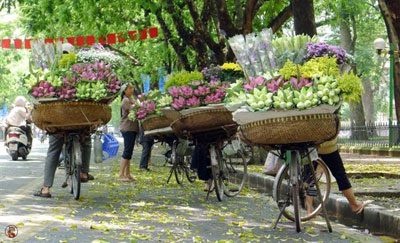
Pick up at your hotel, drive to Nhat Tan village, just on the other side of the river bank of Red river which is very near to the most famous wholesale flower market of Nghi Tam. Take a walk to visit flower farms and local farmer they plant and feed Peach Blossom (symbol of Hanoi flower), Mai (Ochna integerrima) including Yellow Mai and Mountain Mai, Violet, Daisy, Dahlia…
You will continue walk to visit local markets including the one on the side of Nghi Tam street and Hang Luoc. Our car will be waiting for you at the ending point
Return to your hotel. Trip ends.
You can either choose this tour for the morning or afternoon depending your time and remember the gold time for photography.
Inclusive
- Private car/ van
- Mineral water and wet wipe
- Private English speaking local guide
- Entrance fees
Map
- Hanoi, 36 Old Streets (#1104a)
- Vietnamese Street Food, Walking Tour in Hanoi Old Streets (#1104b)
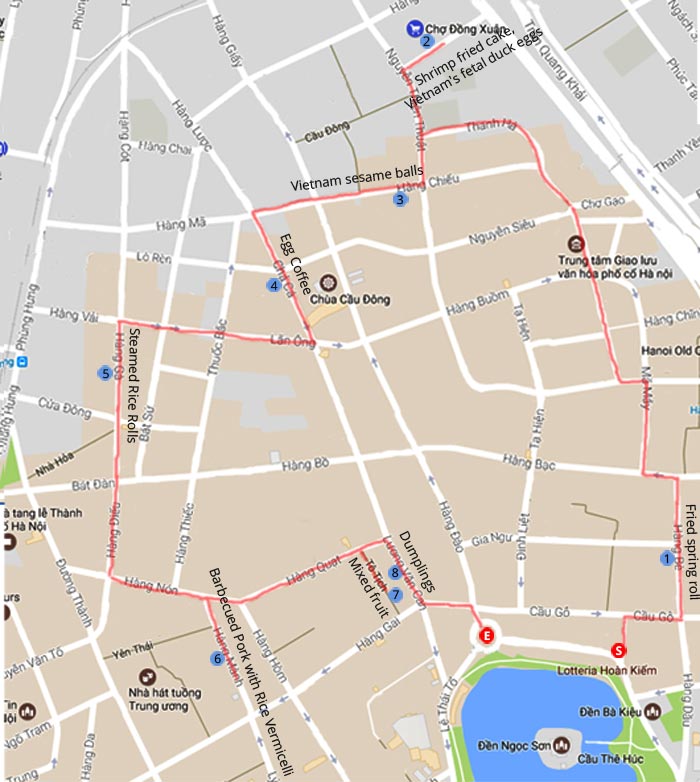
- Map is for reference to street food walking tour, the places can be flexible depending on accurated weather, time ...of trip.